

Subscribe
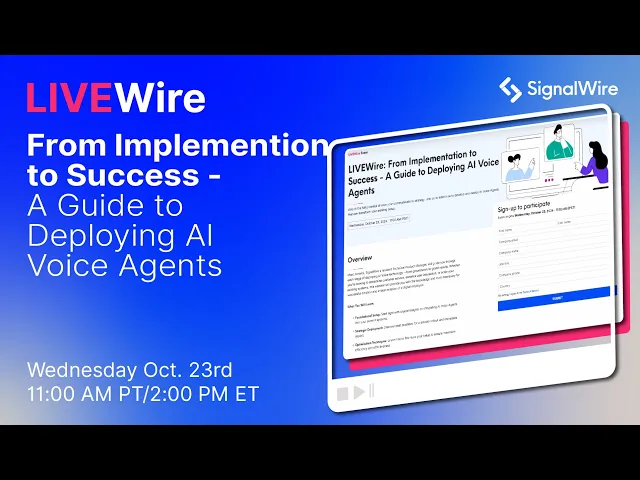
From Implementation to Success: How to Deploy AI Voice Agents That Actually Work
If you’ve been curious about integrating AI into your voice systems but aren’t sure where to start or you're worried about complexity, cost, or disrupting your current setup, this is the webinar you’ve been waiting for.
In our latest LIVEWire session, From Implementation to Success, our hosts walk through how to build and deploy AI-powered voice agents that are flexible, scalable, and actually useful—without ripping out what you already have in place.
Why AI Voice Agents?
AI voice agents are no longer just a novelty. With the right setup, they can now handle 70–90% of routine customer interactions, from answering questions to scheduling appointments, and even summarizing issues before handing the call off to a human agent.
More than just automation, SignalWire’s AI agents are built for contextual awareness, multi-channel orchestration, and real-time data access—which means they’re smart enough to route, respond, and resolve without making your customers repeat themselves.
The Tools That Make It All Possible
Here’s a quick look at the tools Chelsea covers in the webinar:
SignalWire Call Fabric Platform
A developer-first communication stack that makes it easy to build voice, video, and messaging applications with built-in AI functionality.SWIML (SignalWire Markup Language)
A scripting language designed for voice automation, with a built-in editor to validate and test flows without endless debugging.SWAG (SignalWire AI Gateway)
A powerful integration tool that connects your AI agents to external APIs, services, and databases to fetch real-time data during a live call.DataSphere API
Your custom knowledge base for voice agents—curate, tune, and serve up only the data you want your AI to use, without hallucinations.AI Agent Builder & Visual Tools
For those who want to drag-and-drop instead of code from scratch, Agent Builder makes it easy to test and iterate quickly.
Live Demos: Kevin the Bartender & Bobby’s Tables
Two live demos brought the theory to life:
Kevin the AI Bartender: Powered by DataSphere, Kevin pulls cocktail recipes from a structured internal dataset and answers in real-time—no hallucinations, no generic web scraping.
Bobby’s Tables: A Halloween-themed restaurant reservation agent that remembers context throughout the call and delivers a fully automated reservation experience, complete with SMS confirmation.
These demos aren’t canned. They run live, using real components you can build with today and you can grab the code on GitHub to try them yourself.
Built for Developers, Ready for the Real World
Whether you’re in customer support, healthcare, retail, or logistics, this webinar offers a blueprint for how to start with AI voice agents—and scale when you're ready. You don’t need to be a machine learning expert or reinvent your infrastructure. Just plug in what you need, build fast, and deploy smarter.

What is RCS messaging?
Rich Communication Services (RCS) is the next generation of mobile messaging, designed to replace SMS and MMS. It supports high-quality images and video, verified sender identities, read receipts, typing indicators, and interactive elements like carousels and quick replies, all within the phone's native messaging app.
What is RCS Business Messaging (RBM)?
RCS Business Messaging (RBM) applies RCS capabilities to brand-to-consumer communication. It lets businesses message customers from a verified brand identity instead of a phone number, share rich media and documents, offer quick replies and CTAs, and handle actions like appointment confirmations and payments without the customer leaving the chat.
Is RCS replacing SMS?
RCS is positioned as the successor to SMS, but the transition is gradual. Businesses should adopt RCS where supported while keeping SMS and MMS as fallback channels for devices and networks that don't yet support it.
Does iPhone support RCS?
Yes. Apple added RCS support starting with iOS 18, with RCS Business Messaging support arriving in iOS 18.1. Combined with existing Android support, this brings RCS to the large majority of smartphones in the US.
Is RCS more effective than SMS for customer engagement?
Yes. Nearly 80% of consumers say RCS makes them more likely to engage with a brand, and RCS campaigns can achieve click-through rates up to 7x higher than SMS thanks to rich media, interactivity, and verified sender trust.
ow do businesses start sending RCS messages?
Businesses must first register an RCS agent, an approval process involving Google, aggregators, and mobile operators. From there, they can define use cases like marketing, customer service, or appointment reminders. SignalWire guides businesses through registration and campaign planning.
Which industries benefit most from RCS?
Retail, finance, and healthcare are early leaders. Retailers use RCS for in-chat purchases and product carousels, financial institutions use it for secure verified messaging and account alerts, and healthcare providers use it for appointment scheduling and reminders.
Related Resources